
Choosing China’s top Casino Lighting Solutions suppliers requires more than comparing prices or polished product photographs. A dependable supplier should understand gaming environments, hospitality design, electrical safety, and long operating hours. This guide examines manufacturers that combine technical competence with documented project experience, responsive support, and transparent quality controls.
Paul Gregory, founder of Focus Lighting and an experienced architectural lighting designer, once said, “Lighting is the jewelry of architecture.” The comparison is useful here. Casino lighting must create visual excitement without producing glare across gaming tables, reflective floors, digital screens, or surveillance monitors. Good suppliers can recommend dimming systems, high color-rendering fixtures, precise beam angles, and durable materials. They should also explain testing results clearly, rather than hiding behind attractive catalog language.
Details matter.
A strong evaluation should include factory capability, photometric files, warranty terms, replacement access, and installation guidance. Ask for physical samples. Observe their beam consistency under warm and cool color temperatures. Review how their products perform in corridors, entrances, restaurants, and gaming areas. Energy efficiency matters, but comfort and maintainability matter too. A lower wattage fixture is not automatically the better choice.
This review also recognizes an uncomfortable point: supplier rankings are never completely objective. Project budgets, regional service, design preferences, and changing certifications can alter the outcome. A supplier that performs well in a luxury resort may not suit a smaller venue. Therefore, readers should verify current compliance documents and request references before signing contracts. The best Casino Lighting Solutions partner is not always the most visible one. It is the supplier that can prove performance after installation, when the cameras run, the guests arrive, and maintenance becomes unavoidable.
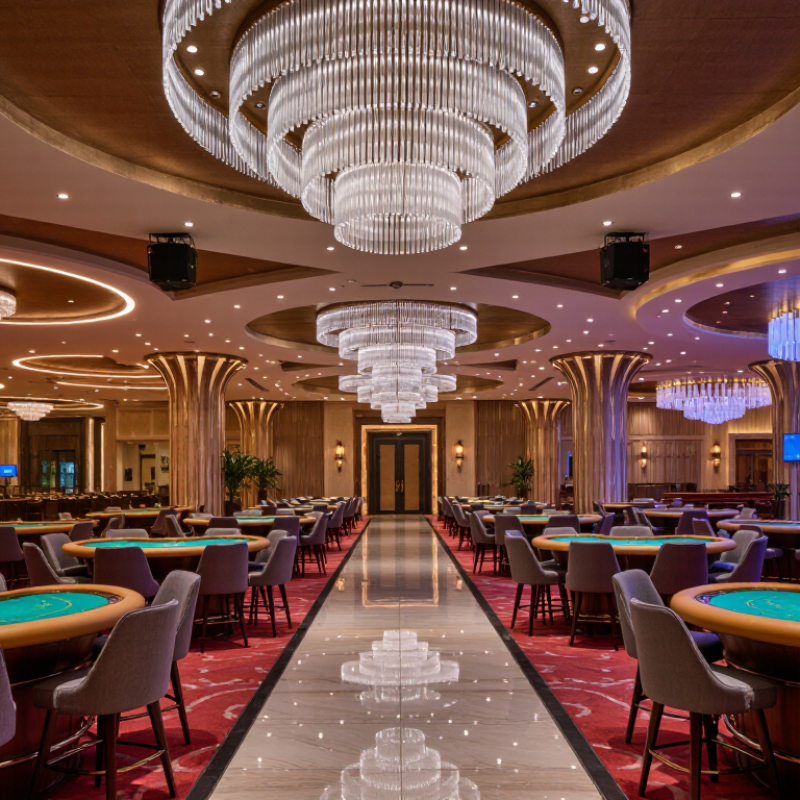
China’s casino lighting solutions market is moving toward connected, efficient, and visually controlled systems. Grand View Research valued the global smart lighting market at USD 20.52 billion in 2023. It also forecasts a 20.6% compound annual growth rate from 2024 to 2030. This growth supports China’s strong supplier base, especially in LED modules, controls, custom fixtures, and architectural integration.
The supplier landscape is broad but uneven. Established factories usually provide photometric files, dimming compatibility, color consistency, and project-based testing. These details matter in casino hotels, where ceiling glare, reflective surfaces, and camera visibility can affect the guest experience. Suppliers commonly support DALI, DMX, and wireless control platforms. Energy performance is also important. The International Energy Agency has repeatedly identified efficient lighting as a major electricity-saving opportunity in buildings.
Specifications alone are not enough. A 2024 supplier review should examine samples, thermal performance, driver replacement, and after-sales response. Some catalogs still emphasize wattage instead of glare control. That is a weakness. Buyers should request LM-80 or equivalent LED reliability evidence, flicker measurements, and installation references in large entertainment venues. China offers competitive customization and production capacity, but quality inspection remains essential. A low quotation may conceal weaker drivers, unstable color output, or limited documentation. Careful verification wins.
Casino environments need more than bright decorative fixtures. They require controlled light, stable color, and comfortable visibility across gaming floors, lounges, corridors, and entrances. Reputable suppliers in China typically provide LED downlights, linear fixtures, wall washers, chandeliers, strip lights, and programmable decorative systems.
Warm white lighting around 2700K to 3000K can create an inviting atmosphere. High color rendering, preferably CRI 90 or above, helps fabrics, finishes, and table details appear natural. Anti-glare lenses reduce eye fatigue near reflective surfaces. Flicker-free drivers also support cameras, digital displays, and long operating hours.
DMX512 supports dynamic scenes and synchronized effects. DALI can manage dimming in selected architectural areas. Wireless control may simplify renovation work, but signal reliability needs testing. Suppliers should provide photometric files, sample fixtures, driver specifications, and safety documentation before production. A full-scale mock-up is valuable because drawings rarely reveal glare from polished floors or ceiling reflections.
Weather-resistant fixtures may suit outdoor entrances and covered walkways. Emergency lighting must remain independent and clearly visible.
Some suppliers promise dramatic color effects, yet excessive animation can distract guests and increase maintenance demands.
Color consistency may also drift between production batches. I would request a batch test, spare components, and a written warranty.
Even experienced project teams sometimes underestimate heat management above decorative ceilings. That mistake becomes expensive later.
China Top Casino Lighting Solutions Suppliers?
Evaluating China’s casino lighting suppliers requires more than comparing quotations. Start with photometric evidence. Ask for IES files, measured lumen output, beam angles, CRI, R9, and TM-30 results. These documents reveal whether lighting will render red carpets, gold finishes, and skin tones accurately. The International Energy Agency’s 2024 Energy Efficiency report estimates that lighting uses about 5% of global electricity. Efficient equipment matters, but visual comfort matters too. A dimmer that flickers can damage the guest experience, even when energy figures look impressive.
Review manufacturing consistency, not only a sample unit. Request LM-80 and TM-21 data, thermal testing, IEC 62471 photobiological safety reports, and DALI-2 or equivalent control compatibility. Check whether the supplier can provide replacement parts after installation. A factory audit, video inspection, or third-party quality report adds useful evidence. Yet paperwork can be polished. Inspect the actual extrusion, driver brand, cable joints, and emergency-lighting behavior. Small details often decide maintenance costs.
Tips: Compare suppliers using the same technical brief. Require a mock-up with the real ceiling height, finishes, and control system. Measure flicker, glare, and color consistency onsite. The U.S. Department of Energy reports that advanced commercial LED packages can exceed 150 lumens per watt, but that figure does not guarantee a successful project. A cheaper quotation may be reasonable. It may also hide weaker drivers, limited warranty support, or unstable color after months of operation. Ask difficult questions early. Then record every answer.
China Top Casino Lighting Solutions Suppliers?
Leading Chinese suppliers are increasingly judged by product expertise and project capability, not catalog size. The global casino market is projected to grow at about 6% annually through 2030, according to Grand View Research. This expansion raises demand for lighting that supports circulation, atmosphere, safety, and operational efficiency. Experienced Chinese manufacturers typically offer low-glare downlights, tunable white systems, decorative pendants, façade fixtures, and DMX-controlled architectural lighting. Product depth matters.
Project delivery separates capable suppliers from ordinary factories. A serious supplier should provide photometric files, mock-up testing, fire-rated options, emergency-lighting coordination, and documented quality control. The International Energy Agency reports that lighting represents roughly 15% of global electricity consumption, making efficiency a practical design concern. In casino environments, however, excessive brightness can damage visual comfort. Dimming must be precise. Color consistency matters.
Suppliers with project experience can coordinate ceiling plans, gaming-area sightlines, hospitality zones, and maintenance access before production begins. Look for in-house optical engineers, sample approval procedures, IP and electrical test records, and export documentation. ISO-based quality systems help, but certificates alone prove little. Site references are stronger evidence. A weakness remains common: some suppliers optimize fixture price before studying the complete lighting scene. That can create glare, uneven color, or costly replacements. Careful buyers should request a small-scale installation first, then review lux levels, beam control, finish quality, and control stability before approving the full order.
A supplier-profile comparison for casino, gaming, hospitality, entertainment, and high-end commercial lighting procurement. Company and brand names are intentionally omitted.
| Supplier Profile | Primary Product Expertise | Casino Application Fit | Typical Technical Scope | Project Capability | Compliance and Quality Evidence to Request | Best Procurement Use |
|---|---|---|---|---|---|---|
| Profile A Architectural LED Specialist |
Linear LED Profile Lighting Recessed Systems | Gaming floors, corridors, ceilings, feature walls, back-of-house circulation, and discreet architectural accents. | Continuous or modular lengths; tunable white and RGB/RGBW options; dimming through commonly specified control protocols; aluminum profiles with diffusers. | Strong for coordinated ceiling and millwork packages; suitable for multi-zone lighting schedules when shop drawings and control diagrams are required. | Request LM-80/TM-21 data where applicable, photometric files, lumen-maintenance information, flicker test results, insulation and thermal test records, and applicable CE/RoHS documentation. | Projects requiring concealed lighting, consistent lines, custom lengths, and integration with interior architecture. |
| Profile B Decorative Fixture Manufacturer |
Chandeliers Pendant Fixtures Custom Decorative Lighting | Casino entrances, VIP rooms, restaurants, lounges, atriums, hotel lobbies, and entertainment venues. | Custom dimensions, metal finishes, glass or crystal elements, layered illumination, LED modules or replaceable lamps, and coordinated canopy systems. | Well suited to one-off or repeat decorative packages; capability depends on engineering drawings, prototype approval, structural coordination, and packing requirements. | Request material specifications, finish samples, electrical safety reports, load and suspension details, installation manuals, replacement-part availability, and prototype inspection records. | Projects where visual identity, custom form, finish consistency, and feature-installation coordination are priorities. |
| Profile C Commercial Downlight and Spotlight Specialist |
Downlights Track Spots Gimbal Fixtures | Gaming tables, slot-machine zones, retail areas, restaurants, meeting rooms, and circulation spaces requiring controlled beam angles. | Multiple beam options; adjustable tilt and rotation; selectable color temperature on some product families; glare-control accessories; separate or integral drivers. | Effective for repeatable room-by-room specifications and standardized replacement programs across multiple property areas. | Request IES/LDT files, UGR data where relevant, color consistency information, driver specifications, dimming compatibility, ingress-protection ratings, and sample-unit testing. | Projects needing consistent illumination, controlled glare, simplified maintenance, and efficient fixture standardization. |
| Profile D Outdoor and Façade Lighting Specialist |
Floodlights Wall Washers In-Ground Fixtures Underwater Options | Casino façades, porte-cochères, fountains, landscape features, pedestrian routes, signage surroundings, and resort exteriors. | Directional optics; RGB/RGBW or white-light versions; corrosion-resistant housings; cable and connector options; weather-exposed installation accessories. | Suitable for exterior packages when drainage, cable routing, thermal management, aiming plans, and access for maintenance are addressed in the design stage. | Request IP-rating test evidence, corrosion-resistance information, outdoor temperature limits, surge-protection details, photometric files, cable specifications, and installation method statements. | Projects with prominent façades, resort landscaping, water features, or programmable exterior scenes. |
| Profile E Intelligent and Dynamic Lighting Integrator |
DMX/RDM Systems Pixel Lighting Control Panels | Entertainment zones, media façades, immersive ceilings, stage-adjacent spaces, themed attractions, and programmed casino features. | Addressable luminaires; scene programming; time schedules; centralized control; network gateways; commissioning and operator training. | Best for projects requiring synchronized lighting scenes, control zoning, integration drawings, commissioning, and post-installation programming support. | Request control topology, channel and address schedules, system compatibility statements, cybersecurity requirements for networked systems, backup procedures, and commissioning protocols. | Projects where dynamic effects, synchronized scenes, operational flexibility, and show-control coordination are essential. |
| Profile F Hospitality Lighting Project Supplier |
Hotel Lighting Guestroom Fixtures Public-Area Packages | Integrated casino resorts, hotel guestrooms, corridors, restaurants, spas, retail areas, and public amenities. | Bedside and reading lights; decorative pendants; bathroom fixtures; corridor lighting; table lamps; emergency-lighting coordination; finish and hardware matching. | Strong for package procurement across multiple interior zones; success depends on sample-room approval, room-type schedules, finish boards, and coordinated installation documents. | Request sample-room references, finish-control procedures, component replacement plans, electrical reports, fire-related documentation where required, and packaging protection standards. | Large resort developments seeking one coordinated source for decorative, architectural, and guestroom lighting packages. |
| Profile G OEM/ODM Custom Lighting Factory |
Private-Label Production Custom Housing Low-Volume Prototypes | Unique gaming furniture lighting, branded interior concepts, custom signage illumination, and bespoke fixture families. | Design-for-manufacture support; custom tooling; sample development; component substitution review; finish and packaging customization. | Useful for proprietary designs and repeat production, provided the supplier can control engineering revisions, tooling ownership, quality inspection, and production traceability. | Request factory audit records, bill-of-materials control, engineering change procedures, first-article inspection, production quality plans, warranty terms, and spare-part commitments. | Projects requiring exclusive designs, controlled repeat production, customized finishes, or non-standard dimensions. |
Procurement note: Technical performance, certifications, lead times, warranty terms, and project references vary by factory and product series. Confirm all values through current test reports, approved samples, photometric files, inspection records, and project-specific submittals before award.
Selecting China’s top casino lighting solutions suppliers requires more than comparing unit prices. Procurement teams should review photometric files, LED binning, driver efficiency, dimming curves, installation tolerances, and replacement lead times. The U.S. Department of Energy reports that LED products can use up to 75% less energy and last 25 times longer than incandescent lighting. This supports lifecycle costing, not just purchase-price analysis. Ask for samples under actual ceiling heights and carpet colors. Small details matter.
Customization should match the gaming floor, hotel corridors, restaurants, and service areas. Suppliers should provide glare control, color consistency, programmable scenes, and compatible control protocols. According to the International Energy Agency, lighting represents about 15% of global electricity consumption. Efficient design can therefore reduce operating pressure, although savings depend on controls and maintenance. My concern is simple: many proposals promise dramatic savings without showing measured lux levels or operating hours.
Compliance requires documented testing, not attractive certificates alone. Request reports covering EMC, electrical safety, RoHS requirements, and IEC 62471 photobiological safety where applicable. Confirm whether documents match the exact model and production batch. After-sales terms should define spare-part quantities, response times, warranty exclusions, and remote troubleshooting procedures. A factory audit can review aging tests, driver reserves, and final inspection records. Mistakes remain possible. Even experienced buyers should record every change in a signed technical schedule.
Product expertise and project delivery matter more than a large catalog. Look for optical engineers, mock-up testing, quality records, and export experience. Catalogs can mislead.
Typical products include low-glare downlights, tunable white systems, decorative pendants, façade fixtures, and architectural lighting. Different zones need different beam angles and brightness levels.
Excessive brightness can cause visual discomfort and reflections on screens or polished surfaces. Suppliers should provide beam-control data and dimming tests. Bright is not always better.
Request photometric files, LED binning details, driver data, test reports, and installation tolerances. Also check emergency-lighting coordination and maintenance access. Documents must match the exact model.
Compare driver efficiency, operating hours, dimming performance, and expected replacement needs. Lifecycle cost gives a clearer picture than unit price alone. Promised savings need evidence.
Test the fixtures under the actual ceiling height, carpet color, and surrounding finishes. Review lux levels, beam uniformity, glare, color consistency, and control stability. Small tests reveal expensive mistakes.
Lighting should suit gaming floors, hotel corridors, restaurants, service areas, and façades. Useful options include programmable scenes, compatible control protocols, adjustable color temperature, and glare reduction. One design rarely fits every zone.
Ask for electrical safety, electromagnetic compatibility, material, and photobiological safety records where applicable. Confirm that reports cover the exact product and production batch. Certificates alone prove little.
Contracts should define spare-part quantities, response times, warranty exclusions, and remote troubleshooting procedures. Factory audits can review aging tests, driver reserves, and final inspection records. Support may still be slower than expected.
Avoid choosing fixtures only because they have the lowest price. Low-cost products may create glare, uneven color, or frequent replacements. Record every design change in a signed technical schedule.
China’s Casino Lighting Solutions market is developing through a combination of advanced manufacturing, flexible customization, and growing project experience. Suppliers provide a broad range of products, including LED architectural lighting, decorative fixtures, dynamic color-changing systems, intelligent controls, energy-efficient solutions, and lighting designed for hospitality, entertainment, and gaming environments. These technologies can help create clear visual zones, enhance atmosphere, support wayfinding, and coordinate lighting with interior design while maintaining operational efficiency.
When evaluating Chinese suppliers, buyers should consider product quality, technical expertise, production capacity, project references, customization capabilities, and communication efficiency. It is also important to review certifications, electrical safety requirements, environmental standards, installation guidance, warranty terms, spare-parts availability, and after-sales support. Leading suppliers may differ in their strengths, with some focusing on specialized products and others offering complete project solutions from lighting design and sample development to manufacturing and installation assistance. A structured procurement process and clearly defined technical specifications can reduce risk and improve long-term project performance.